

Supply vs Delivery: How Electric Bills Are Structured
Many businesses are surprised when electricity delivery charges exceed the cost of the electricity itself. Understanding why electricity delivery charges are so high requires understanding demand charges and peak demand on commercial electric meters.
Supply charges represent the cost of the electricity itself and are based on the total energy consumed during the billing period. These charges are measured in kilowatt-hours (kWh) and typically fall in the range of about $0.07 to $0.10 per kWh in 2026.
Delivery charges represent the cost of transporting electricity across the grid and maintaining the infrastructure required to serve the site. These charges often include a demand-based component measured in kilowatts (kW). Demand charges are typically billed at rates in the range of $10 to $15 per kW depending on the tariff.
Because supply is measured in energy (kWh) while delivery demand charges are based on peak power (kW), the delivery portion of a commercial electric bill can sometimes exceed the cost of the electricity itself. Delivery vs supply charges side by side shows the two halves on a home bill and a shop bill reconciled to the cent: 42 percent delivery on one, 65 percent on the other.
Why Delivery Charges Can Be Higher Than Supply Charges
Delivery charges can exceed supply charges because demand charges are based on the single highest power interval recorded during the billing period.
Most commercial electric meters measure demand in 15- or 30-minute intervals. During each interval the meter calculates the average power draw in kilowatts. The highest interval recorded during the month becomes the site's peak demand.
This means a single event can determine the demand charge for the entire billing period.
For example, in a factory operating at full production, the peak interval may occur when multiple systems operate simultaneously. Production equipment, compressors, and HVAC loads may overlap, creating a short interval where the total demand is significantly higher than the facility's typical load.
In smaller facilities, the peak may be driven by a single piece of equipment such as an air compressor operating continuously during one interval.
Because utilities must maintain infrastructure capable of serving these peak loads, demand charges allocate the cost of that capacity to customers based on their highest recorded demand.
Demand Charges: The Hidden Driver of Delivery Costs
Demand charges are often the largest driver of delivery costs on commercial electricity bills. Unlike supply charges, which accumulate gradually with energy consumption, demand charges are determined by a single measurement.
Utilities calculate demand charges using the following relationship:
Demand Charge = Peak Demand (kW) x Demand Rate ($/kW)
The peak demand value is determined by the highest interval demand recorded during the billing period.
Because this charge is based on the highest interval rather than total energy use, even a short spike in electricity demand can significantly increase delivery costs.
Your electric bill is not only determined by how much energy you use, but by the capacity the grid must stand ready to provide.
How Utilities Calculate Delivery Charges
Delivery charges are defined by the utility tariff and typically include several components.
Customer charges recover fixed service costs.
Energy-based delivery charges recover the cost of transporting electricity across the distribution network.
Demand charges recover the cost of maintaining grid capacity capable of serving peak loads.
Depending on the utility, demand charges may appear on the bill under different names. For example, in some territories they appear as a "Demand Charge," while in others they may appear as a "Distribution Facility Charge."
Although the terminology varies, the underlying mechanism is the same: the highest demand interval during the billing period determines the capacity required to serve the site.
How ComEd Calculates the Delivery Demand Charge: A Worked Example
On ComEd commercial accounts, the delivery demand charge appears as the Distribution Facilities Charge (DFC). It follows the same demand-charge mechanism, but two ComEd-specific rules determine exactly which moment of the month sets it.
First, ComEd measures billed demand as the highest 30-minute demand recorded during the on-peak window: 9:00 AM to 6:00 PM, Monday through Friday, excluding holidays. Power drawn outside that window does not set billed demand, no matter how high it climbs.
Second, the DFC is a flat rate per kilowatt of that billed demand. On a Rate RDS commercial account at secondary voltage, the 2025 DFC reconciled to $14.59 per kW.
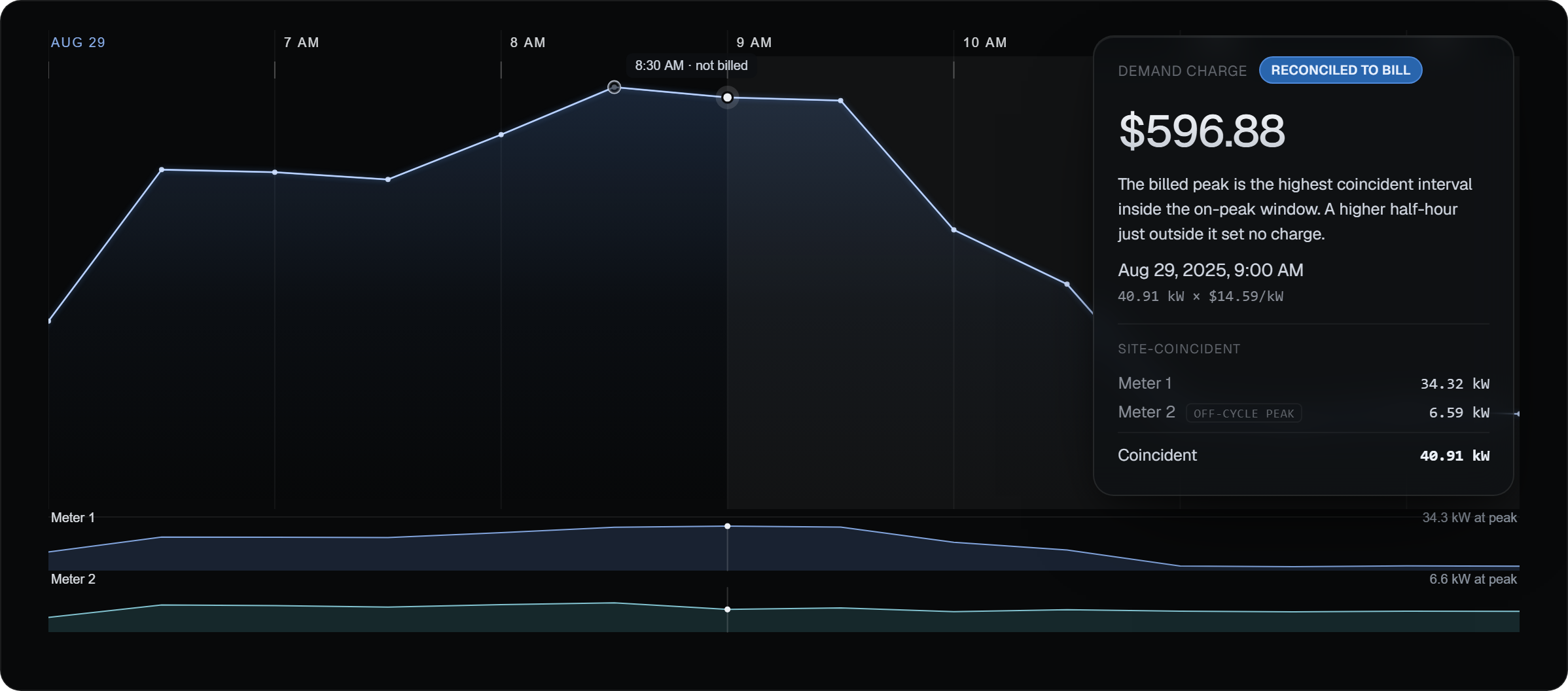
For a small commercial site with a 40.91 kW billed demand, at that $14.59 per kW rate the Distribution Facilities Charge came to $596.88 on the bill.
That single line can exceed the entire energy supply charge for the month. And the bill shows only the result, $596.88, not the one 30-minute interval between 9:00 AM and 6:00 PM that created it. Two sites with identical monthly energy use can pay very different charges depending on when their peak landed. Reconstructing which interval set the charge, and whether it fell inside the on-peak window, requires the interval data behind the bill.
In this reconciled bill the interval data showed the boundary rule at work. The site's single highest interval of that day was 41.94 kW at 8:30 AM, yet it set no demand charge, because it fell before the 9:00 AM on-peak start. The billed 40.91 kW peak was the very next interval, at 9:00 AM, as the same morning ramp crossed the window boundary. The physical peak of the day and the billed peak sat thirty minutes and about one kilowatt apart, and only the interval data reveals which one the bill actually used. You can reconstruct the interval that set your own charge, reconciled to your bill, with the free demand charge tool. That reconstruction needs your interval export, which most accounts have to request before they can use it. If you do not have it yet, start where you already are: the free ComEd bill reader works from the PDF bill alone, rebuilds each delivery line, checks the arithmetic against what ComEd printed, and can request the interval data from ComEd for you.
Rates and tariff terms change by period. The figures above reflect a reconciled 2025 Rate RDS bill and are not a quote for any other account.
How Businesses Reduce Electricity Delivery Charges
Reducing electricity delivery charges requires lowering the site's peak demand.
In some cases peak demand occurs when multiple loads operate simultaneously. If those loads are flexible, it may be possible to separate them into different intervals so they no longer overlap.
However, this strategy only works if there is unused capacity in nearby intervals. If demand levels are already high throughout the operating day, shifting equipment operation may simply move the peak to another time rather than reduce it.
Effective demand reduction therefore depends on understanding the facility's full interval load profile and identifying whether flexible loads and unused capacity exist around the peak interval.
Why Electricity Bills Alone Cannot Explain Your Costs
A monthly electricity bill summarizes total charges but does not reveal how demand was created during the billing period.
Because demand charges are determined by the highest interval, understanding the causes of high delivery costs requires examining the facility's interval demand data.
In some facilities the load profile shows sustained demand during operating hours. In these cases there may be little opportunity to reduce the peak because demand remains consistently high.
In other facilities the peak may be driven by short events such as an air compressor operating continuously during a single interval. These situations may present opportunities for operational adjustments or equipment changes.
Without interval data, however, it is difficult to determine whether demand reduction is possible or whether the peak demand reflects normal operating conditions.
Why is my delivery charge higher than my electricity usage?
Electricity delivery charges include more than the energy you consume. They also recover the cost of maintaining the transmission and distribution network and often include demand charges based on the highest level of power your facility draws during a billing interval. Because demand charges are based on peak usage rather than total energy, the delivery portion of a bill can exceed the energy supply charges.
How does ComEd calculate the delivery demand charge on a commercial bill?
On ComEd commercial accounts the delivery demand charge is the Distribution Facilities Charge (DFC), billed as a flat rate per kilowatt of billed demand. ComEd defines billed demand as the highest 30-minute demand recorded between 9:00 AM and 6:00 PM on weekdays during the billing period. On a 2025 Rate RDS account at secondary voltage the DFC reconciled to $14.59 per kW, so a 40.91 kW billed demand produced a $596.88 charge on the bill. The bill shows the total but not the specific 30-minute interval that set it.
Why did my electricity delivery charge increase this month?
Delivery charges can increase when the facility sets a higher peak demand during the billing period or when utility tariff rates change. Even a short interval of unusually high power usage can raise the billing demand used to calculate demand charges, increasing the delivery portion of the bill for that month.
What determines electricity delivery charges?
Electricity delivery charges are determined by the structure of the utility tariff. They typically include fixed customer charges, distribution system charges, transmission charges, and demand charges based on peak power usage. The exact components and rates depend on the utility's rate design and the customer's service classification.
Is it normal for delivery charges to be higher than supply charges?
Yes. In many commercial electricity tariffs the delivery portion of the bill includes infrastructure costs and demand charges tied to peak demand. When a facility sets a high peak demand relative to its total energy usage, delivery charges can exceed the cost of the electricity supply itself.
What causes peak demand spikes on electric meters?
Peak demand spikes occur when several large electrical loads operate at the same time during a billing interval. Equipment such as compressors, HVAC systems, pumps, or industrial machinery can temporarily raise the facility's power demand. If these loads overlap during a 15 or 30 minute interval, they may establish the peak demand used to calculate demand charges.
Why can two businesses using the same electricity pay different delivery charges?
Two facilities can consume similar amounts of total energy but have very different demand patterns. A business that operates equipment continuously may maintain a stable demand profile, while another may run several large loads at the same time, creating higher peak demand. Because delivery charges often depend on peak demand rather than total energy usage, the resulting costs can differ significantly.
Why does my electric bill stay high even when electricity usage drops?
Electric bills can remain high when demand charges dominate the cost structure. Demand charges are based on the highest power interval recorded during the billing period, not the total energy consumed. If a facility sets a high peak demand early in the month, that value can determine a large portion of the delivery charges even if overall electricity usage later declines.
References
Referenced by
- 01Which Ameren Illinois Rate Zone Are You In, and Does It Change What You Pay?
- 02Ameren Illinois or ComEd: Does a Quote for One Site Transfer to the Other?
- 03ComEd Price to Compare: Is a Supplier Offer Cheaper for Your Business?
- 04Every Line on a ComEd Bill, What It Costs, and Whether You Can Avoid It
- 05Is ComEd Budget Billing Worth It?
- 06Carbon-Free Energy Resource Adj: The Biggest Rider on a ComEd Bill Is a Credit
- 07What Is the Coal to Solar and Energy Storage Line on a ComEd Bill?
- 08ComEd Commercial Rates: What You Actually Pay
- 09The ComEd Customer Charge, and Why Using Less Power Makes Your Rate Look Worse
- 10Your ComEd Delivery Charge Became Several Lines in 2026. Did the Price Actually Change?
- 11Which ComEd Delivery Class Is Your Business In, and Is It Worth Staying Under a Threshold?
- 12Does ComEd Ratchet Your Demand Charge? What One Bad Month Actually Costs
- 13The ComEd Distribution Facilities Charge, Explained
- 14The Energy Efficiency Programs Line on a ComEd Bill, and Who Can Opt Out
- 15What Is the Environmental Cost Recovery Adj on a ComEd Bill?
- 16The IL Electricity Distribution Charge on a ComEd Bill, Explained
- 17Who Pays to Extend ComEd's Lines to Your New Site?
- 18What Is Low Income Discount Recovery on a ComEd Bill?
- 19Can You Move Your Peak Outside ComEd's 9-to-6 Window, and What Would It Save?
- 20ComEd Nonresidential Delivery Service Charges by Delivery Class, 2024 to 2027
- 21Is ComEd Primary Voltage Service Worth It for Your Business?
- 22ComEd Rate Datasets: Four Downloadable Records of the Filed Charges
- 23ComEd Residential Delivery Service Charges by Delivery Class, 2024 to 2027
- 24Does Your Solar or Battery Need ComEd Rider POG?
- 25Rider ETAC, ZEA, CFRA and REA Are on Every ComEd Bill. Can You Avoid Any of Them?
- 26State Tax and Municipal Utility Tax on a ComEd Bill: the Filed Rates, and What the Bill Does Not Tell You
- 27ComEd Supply Charges by Customer Group: Every Filed Window Since September 2025
- 28ComEd Price to Compare: The Current Supply Rate and Every Posted Month Since 2017
- 29Delivery vs Supply Charges on an Electricity Bill: Which Half Is Which, and Which One You Can Change
- 30How ComEd's Commercial Tariff Is Structured: Rate RDS and Its Three Charges
- 31How to Read a ComEd Commercial Electricity Bill: kW, kWh and Demand
- 32How to Reduce My ComEd Bill
- 33Illinois Shines and Net Metering: Which Commercial Solar Incentives Pay?
- 34Is ComEd a Monopoly? Half of Your Bill Is, and the Bill Shows You Which Half
- 35What is Peak Demand?
- 36Why Are Ameren Illinois Rates Going Up? The Posted Price to Compare, Month by Month
- 37Why Are Illinois Electric Rates Going Up? The Posted ComEd Record, Month by Month
- 38Your ComEd Business Bill Jumped. Which of the Four Causes Was It?
- 39Your Ameren Illinois Bill Is High. Which Part of It Actually Moved?