

How to Identify a Commercial Electricity Bill
A commercial electricity bill can be identified by three structural features that rarely appear on residential electricity bills: a demand charge measured in kilowatts (kW), a nonresidential delivery class such as Small Load or Large Load, and separate sections for electricity supply and electricity delivery.
Demand charge (kW)
Commercial bills include a demand charge based on the highest level of electricity demand recorded during the billing period. The charge is typically calculated as peak demand (kW) multiplied by a demand rate ($/kW). Residential electricity bills do not include demand charges and only bill for energy usage in kilowatt hours (kWh).
Nonresidential delivery class
Commercial accounts are usually assigned a delivery class such as Small Load, Medium Load, or Large Load. Utilities use these classes to categorize facilities according to their peak electrical demand.
Separate supply and delivery charges
Commercial electricity bills usually separate the cost of electricity supply from the cost of delivery through the utility grid. Supply represents the cost of purchasing electricity from a supplier, while delivery represents the cost of transporting electricity and maintaining the grid infrastructure.
If a bill includes a demand charge based on peak demand and separates supply and delivery charges, it is almost always a commercial electricity account.
Example of a Commercial Electricity Bill
Identifying a commercial electricity bill begins with understanding the two major components that determine most electricity costs: electricity supply and electricity delivery.
Supply represents the cost of purchasing electricity from the supplier. It is calculated by multiplying total electricity usage, measured in kilowatt hours (kWh), by the electricity supply rate.
Supply cost = electricity usage (kWh) x supply rate ($/kWh)
For a facility that uses about 80,000 kWh in a billing period at a supply rate near $0.10 per kWh, the supply cost is roughly:
80,000 kWh x $0.10 = $8,000
This represents the portion of the bill associated with purchasing the electricity itself.
Delivery represents the cost of transporting electricity through the utility grid and maintaining the infrastructure required to serve the facility. Delivery charges typically include a demand charge based on peak power demand. Delivery charges are explained in detail in the article on why electricity delivery charges can be high.
Demand charge ($) = peak demand (kW) x demand rate ($/kW).
Demand charges are explained in more detail in the article on what a demand charge is and how utilities calculate it.
Peak demand is the highest metered power demand recorded during the billing period. Even if that level of demand occurs only briefly, the electrical grid must be capable of supplying it.
For the same facility, a peak demand near 240 kW billed at a demand rate around $15 per kW produces:
240 kW x $15 = $3,600
A demand charge of this size can account for the large majority of the delivery portion of the bill, even though it derives from a single interval rather than from total energy use.
The grid must be built to serve your highest demand, not your average usage.
How Utilities Measure Peak Demand
Utilities determine peak demand by identifying the highest level of electrical power a facility draws from the grid during the billing period. This value is measured in kilowatts using interval meters that record electricity usage throughout the day.
Demand is measured in kilowatts (kW), which represent the rate at which electricity is being used at a specific moment. This differs from electricity usage, which accumulates over time and is measured in kilowatt hours (kWh).
A Real Commercial Bill, Reconciled
The line items are easiest to trust once they reconcile against the meter. On one recent ComEd Small Load bill using the utility's 2026 format, the delivery section listed two demand lines explicitly: a Peak Period Distribution Facilities Charge covering 9:00 AM to 6:00 PM on weekdays, and a paired Off Peak line covering all other hours at 0 dollars per kilowatt. The bill states the on-peak-only rule on its own face.
The billed demand on that peak period line was 46.20 kilowatts. Reconstructing it from the site's thirty minute interval meter data produced a site coincident on-peak peak of 46.20 kilowatts, matching the bill, and a recomputed Distribution Facilities Charge equal to the bill to the cent. The demand charge was not an estimate on the bill and not an estimate in the reconstruction. It was the same measured interval, read two ways.
You can put your own bill through the first half of that without any meter data. Upload the PDF to the free ComEd bill reader and it rebuilds each line, checks the charges sum to the total ComEd printed, works out your delivery class by reconciling the demand line to the filed ratebook, and then lists plainly the questions a bill cannot answer on its own.
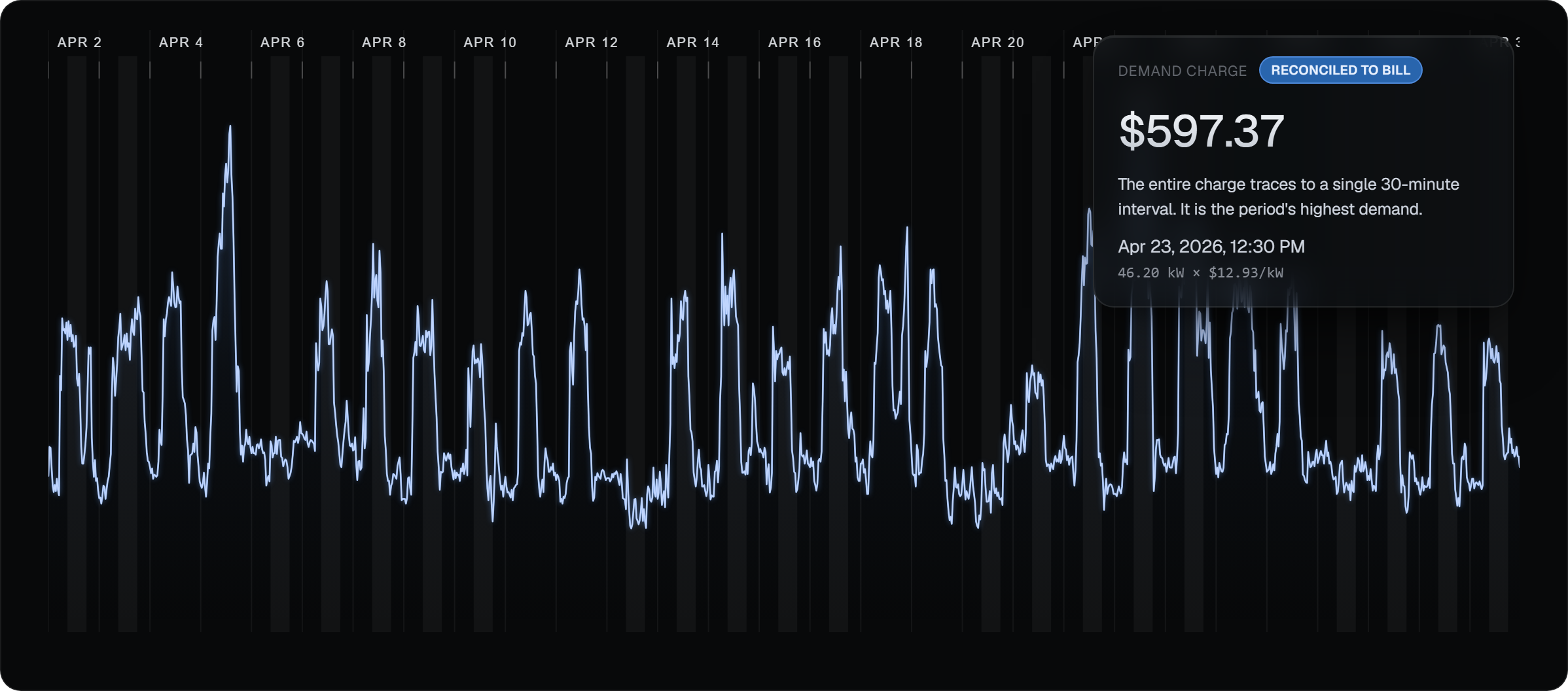
The value of reading a commercial bill this way is not to find an error. On a correctly issued bill there is none. The value is seeing how the charge was constructed, which the bill states but does not show.
Why Electricity Bills Alone Cannot Explain Your Costs
Electricity bills summarize the final billing determinants, but they do not show how electricity demand changes throughout the day.
The bill shows the total electricity usage and the highest recorded demand, but it does not reveal when that demand occurred or what equipment was operating at the time.
For example, the bill may show a peak demand of 240 kW, but it does not explain whether that demand occurred during normal operating hours, during equipment startup, or during a brief spike in electricity usage.
Interval meter data provides a more detailed view by recording electricity demand at regular intervals throughout the day.
By analyzing interval data, building operators can identify when peak demand occurs, which systems are contributing to demand spikes, and whether electricity usage patterns can be adjusted to reduce demand charges.
Without this additional data, the electricity bill alone provides only a partial explanation of electricity costs.
What is the difference between kW and kWh on an electricity bill?
Kilowatts (kW) measure the rate at which electricity is being used at a given moment. Kilowatt hours (kWh) measure the total amount of electricity used over time. Supply charges on commercial electricity bills are based on kWh, while demand charges are based on kW.
What information appears on a commercial electricity bill?
A commercial electricity bill typically includes electricity usage (kWh), peak demand (kW), supply charges, delivery charges, meter information, and taxes or regulatory fees. These values determine how the total electricity cost for the billing period is calculated.
How do you read electricity usage in kWh on a bill?
Electricity usage in kWh represents the total amount of energy consumed during the billing period. This number is multiplied by the electricity supply rate to calculate the supply portion of the electricity bill.
What is load factor on an electricity bill?
Load factor measures how consistently a facility uses electricity relative to its peak demand. Buildings with a low load factor have short periods of very high demand compared to their average electricity use, which can increase demand charges. Our load factor calculator computes yours from two numbers on the bill and shows what it says about your costs.
References
Referenced by
- 01Is the Demand Charge on Your Ameren Illinois Business Bill Worth Attacking?
- 02Does Ameren Illinois Offer Business Hourly Pricing the Way ComEd's Rate BESH Does?
- 03Can You Get Interval Data From Ameren Illinois, and Do You Need It?
- 04Does Ameren Illinois Have Peak Hours, and Do They Cost Your Business Anything?
- 05Which Ameren Illinois Rate Zone Are You In, and Does It Change What You Pay?
- 06Ameren Illinois or ComEd: Does a Quote for One Site Transfer to the Other?
- 07ComEd Price to Compare: Is a Supplier Offer Cheaper for Your Business?
- 08Every Line on a ComEd Bill, What It Costs, and Whether You Can Avoid It
- 09Is ComEd Budget Billing Worth It?
- 10ComEd Capacity Charge: Is It Worth Fighting on a Business Bill?
- 11The ComEd Capacity Charge on Hourly Pricing: What It Is, Why It Rose, and What It Does to the Worth-It Math
- 12Carbon-Free Energy Resource Adj: The Biggest Rider on a ComEd Bill Is a Credit
- 13What Is the Coal to Solar and Energy Storage Line on a ComEd Bill?
- 14ComEd Commercial Rates: What You Actually Pay
- 15The ComEd Customer Charge, and Why Using Less Power Makes Your Rate Look Worse
- 16Your ComEd Delivery Charge Became Several Lines in 2026. Did the Price Actually Change?
- 17Which ComEd Delivery Class Is Your Business In, and Is It Worth Staying Under a Threshold?
- 18Does ComEd Ratchet Your Demand Charge? What One Bad Month Actually Costs
- 19ComEd Demand Charges, Reconciled to the Meter
- 20The ComEd Distribution Facilities Charge, Explained
- 21The Energy Efficiency Programs Line on a ComEd Bill, and Who Can Opt Out
- 22What Is the Environmental Cost Recovery Adj on a ComEd Bill?
- 23ComEd Real-Time Pricing: Which Hourly Price Do You Actually Pay?
- 24ComEd Live Prices: The Last 24 Hours, Every Five Minutes
- 25ComEd Hourly Pricing Negative Prices: What Happens When the Price Goes Below Zero
- 26Are ComEd Rates Lower at Night? Hourly Pricing Overnight, Measured
- 27ComEd Hourly Pricing vs the Flat Rate: Which Homes Actually Save
- 28Is ComEd Hourly Pricing Worth It in Winter?
- 29Is ComEd Hourly Pricing Worth It? What Actually Decides It
- 30The IL Electricity Distribution Charge on a ComEd Bill, Explained
- 31Who Pays to Extend ComEd's Lines to Your New Site?
- 32What Is Low Income Discount Recovery on a ComEd Bill?
- 33Two Meters on One ComEd Site: Which Peak Actually Gets Billed?
- 34ComEd Nonresidential Delivery Service Charges by Delivery Class, 2024 to 2027
- 35Is ComEd's Peak Time Rebate Worth Changing Your Afternoon For?
- 36Is ComEd Primary Voltage Service Worth It for Your Business?
- 37The Purchased Electricity Adjustment on a ComEd Bill: 15 Months of Filed Values
- 38Should Your Business Take ComEd's Hourly Supply, Rate BESH, Instead of a Fixed Rate?
- 39ComEd Rate Datasets: Four Downloadable Records of the Filed Charges
- 40ComEd Residential Delivery Service Charges by Delivery Class, 2024 to 2027
- 41Your Electricity Supplier Pays ComEd for Your Interval Data. Should You Pull It Yourself?
- 42Should Your Business Sign Up for ComEd Rider VLR When the Tariff Names No Price?
- 43Rider ETAC, ZEA, CFRA and REA Are on Every ComEd Bill. Can You Avoid Any of Them?
- 44State Tax and Municipal Utility Tax on a ComEd Bill: the Filed Rates, and What the Bill Does Not Tell You
- 45ComEd Supply Charges by Customer Group: Every Filed Window Since September 2025
- 46ComEd Supply Price and Wholesale Energy Cost, Month by Month, June 2025 to August 2026
- 47ComEd Price to Compare: The Current Supply Rate and Every Posted Month Since 2017
- 48The Demand Charge Nearly Doubled While Usage Fell: A Distillery, Month by Month
- 49Do You Need ComEd Interval Data, or Does Your Bill Already Answer It?
- 50Electric Bill Calculator: Estimate Your Whole Bill, Not Just the Rate
- 51Why Is My Electricity Delivery Charge So High?
- 52Delivery vs Supply Charges on an Electricity Bill: Which Half Is Which, and Which One You Can Change
- 53How ComEd's Commercial Tariff Is Structured: Rate RDS and Its Three Charges
- 54How to Reduce My ComEd Bill
- 55Illinois Shines and Net Metering: Which Commercial Solar Incentives Pay?
- 56Interval Meter Data Analysis: Read Your Own File Free
- 57Is ComEd a Monopoly? Half of Your Bill Is, and the Bill Shows You Which Half
- 58kWh Cost Calculator: What You Actually Pay Per kWh
- 59Load Factor vs Demand Charge: What the Ratio Does to Your Delivery Cost
- 60The Winter Bill Doubled and the Overnight Floor Explains It: A Seasonal Site, Month by Month
- 61What is Peak Demand?
- 62Time of Use Electricity Rates: How They Work and What Decides If They Pay
- 63What Is a Demand Charge on an Electricity Bill?
- 64Why Are Ameren Illinois Rates Going Up? The Posted Price to Compare, Month by Month
- 65Why Are Illinois Electric Rates Going Up? The Posted ComEd Record, Month by Month
- 66Your ComEd Business Bill Jumped. Which of the Four Causes Was It?
- 67Your Ameren Illinois Bill Is High. Which Part of It Actually Moved?
- 68Why Is My ComEd Bill So High? Pick the Question, Get the Read